
Quick Summary
To calculate a shim stack, first gather your fork or shock model, shim diameters, thicknesses and counts, port and bleed hole sizes, oil viscosity and rider weight. Then estimate pressure on the stack, find each shim's stiffness, divide force by stiffness to get deflection, and total the stack's damping force at a given velocity.
- Measure the existing shim stack exactly as installed before changing anything.
- Shim stiffness depends on diameter, thickness and material; thicker, smaller shims are stiffer.
- Calculate deflection by dividing applied force by stack stiffness, one shim at a time.
- Real valves deviate from the simplified maths, so treat results as a starting point.
- Validate calculated damping against a dyno curve, then confirm with controlled riding tests.
Table of Contents
- What You Need Before Calculating a Shim Stack
- Calculating Shim Stack Deflection and Stiffness Step by Step
- Shim Stack Design Examples, Adjustment and Validation
- Frequently Asked Questions
What You Need Before Calculating a Shim Stack
Last Updated: November 22, 2026
Calculating a suspension shim stack starts with the right data, not the right formula. Gather your data before opening a single calculation.
You will need:
- Fork or shock type and model: Note the exact model, year and whether it uses a cartridge or open-cartridge valve.
- Shim measurements: Diameter, thickness and count for each shim in the current stack.
- Port and bleed hole sizes: Measure these with calipers and record them.
- Oil viscosity and temperature: Your calculation assumes a specific oil grade at a set temperature.
- Rider weight with gear and typical pace: These set the damping targets you're designing for.
Measure the existing stack exactly as it sits before changing anything, recording order, shim direction and any worn or bent shims.
For a deeper grounding in the theory, Shim Stack Engineering walks through the worked examples and numbered equations behind these inputs.
Calculating Shim Stack Deflection and Stiffness Step by Step
Shim stack deflection is the bend a stack takes under oil pressure; stiffness is how hard it resists that bend. Together they control the valve's damping force.
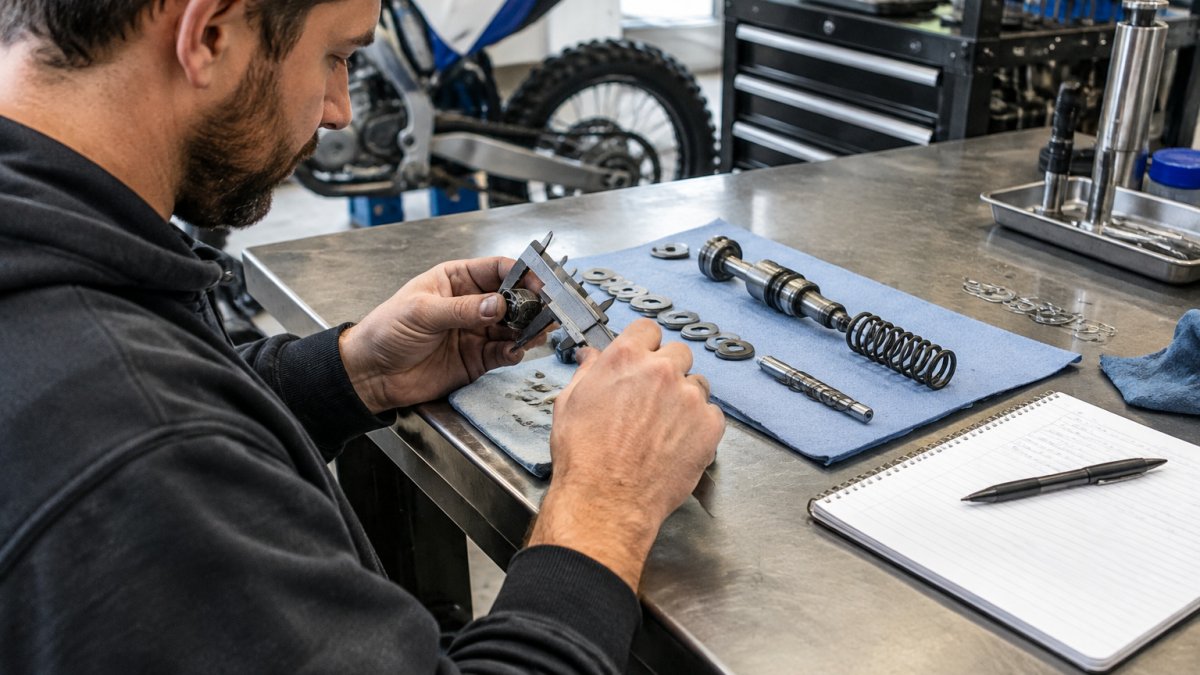
Follow these steps:
- Calculate the pressure differential. Use flow rate and orifice size to estimate pressure on the stack.
- Find the shim's stiffness. Diameter, thickness and material set it; thicker and smaller-diameter shims are stiffer.
- Estimate deflection. Divide applied force by stack stiffness.
- Repeat for each shim. Stack results in order, since each shim sits on the one below.
- Total the damping force. Sum the stack's response to predict damping at that velocity.
Watch out: Flat shim seating and uniform oil flow simplify the maths; real valves deviate, so treat results as a starting point.
Base Valve vs Mid Valve explains how the base and mid valves interact, which you need when your deflection numbers don't match the dyno.
The calculation runs in five steps, each building on the last.
| Step | What to do | Note |
|---|---|---|
| 1. Pressure differential | Estimate pressure on the stack from flow rate and orifice size | Starting input |
| 2. Shim stiffness | Set by diameter, thickness and material | Thicker, smaller shims are stiffer |
| 3. Deflection | Divide applied force by stack stiffness | Per shim |
| 4. Repeat per shim | Stack results in order | Each shim sits on the one below |
| 5. Total damping force | Sum stack response at that velocity | Predicts damping |
Shim Stack Design Examples, Adjustment and Validation
Design examples are the fastest way to see the method work: start with a known stack, change one shim at a time and watch the calculated damping shift.
Changing several shims at once hides which change caused which result. Change one variable, recalculate and record the outcome.
Validate by comparing calculated damping against a dyno curve, then run controlled riding tests on a familiar section. If feel matches the numbers, your model works; if not, check your inputs first.
For the calculations behind design, Suspension Engineering offers professional stack design and validation support. Understanding Damping Curves shows how to match force against velocity, and Shim Stack Calculator for Motorcycle Suspension lets you compare stacks before cutting any metal.
Frequently Asked Questions
How do you calculate a suspension shim stack?
Start by recording shim diameter, thickness, number of shims and the valve port size, then work through oil flow and pressure difference to estimate the bending load on the stack. Calculate deflection for each shim, check how the stack stiffens as shims are added, and compare the result with the damping target for the bike and rider. Treat the output as a starting point, since calculations rely on simplifying assumptions about oil viscosity, temperature and valve geometry, and should be confirmed on a suspension dyno or during controlled riding tests before you rely on them.
What information do you need before calculating a shim stack?
You need the current shim order and the diameter and thickness of each shim, the valve port and piston dimensions, the oil viscosity and operating temperature, and the spring or gas pressure in the system. You should also know the rider weight with gear, the bike's wheel rate or linkage ratio, and the riding conditions the setup must handle. Without these measurements, any shim stack calculation will be an estimate rather than a reliable design.
How do you know which shim to change in a stack?
Match the symptom to the part of the stroke it affects. Harshness over small bumps usually points to the low-speed or edge stack, while wallowing or poor control on larger hits points to the main stack and its stiffness. Change one shim or one variable at a time, record each change, and retest so you can see which adjustment produced the difference you wanted.
