Last Updated: November 17, 2026
Quick Summary
Hydraulic damping converts kinetic energy into heat by forcing suspension fluid through a restriction, so the damper resists wheel velocity rather than supporting the load. As the rod displaces volume, oil must flow through bleed holes, shim stack gaps and fixed orifices, and that restriction creates a pressure difference across the piston that becomes damping force.
- The spring carries the load, but the fluid controls the motion of the suspension.
- Damper rod forks meter oil through fixed orifices, so their damping curve is largely baked in at the factory.
- A shim stack is a self-adjusting valve with no moving parts that responds to oil flow velocity.
- Fork oil grades are not regulated, so a 5W from one brand can differ from another at operating temperature.
- Aerated oil is compressible, so the damper stops generating consistent force and the fork feels vague.
Table of Contents
- How Motorcycle Fork Damping Works: From Wheel Travel to Damping Force
- Damper Rods, Cartridge Forks and Fixed Orifices
- Motorcycle Suspension Shim Stack: How Bending Discs Meter Oil Flow
- Motorcycle Fork Oil Viscosity: Grades, Brands and Real Temperatures
- Fork Oil Aeration and Cavitation: Foam, Fade and Lost Damping
- Springs, Preload, Sag and Air Gap: The Setup That Frames the Damping
- Diagnosing Damping Faults From Rider Symptoms
- Fluid Service Intervals and Oil Replacement Practice
- Book a Suspension Consultation With Mountain Race Shop
- Frequently Asked Questions
How Motorcycle Fork Damping Works: From Wheel Travel to Damping Force
Motorcycle suspension fluid mechanics explained properly starts with one fact: the spring carries the load, but the fluid controls the motion. Every bump compresses a spring, and without hydraulic damping that spring would oscillate uncontrolled. Damping is best understood as a fluid-metering problem.
Hydraulic damping is the conversion of kinetic energy into heat by forcing suspension fluid through a restriction. The damper does not support the bike; it resists velocity. Push the fork slowly and it moves easily. Push it fast and it fights back. That difference is the whole game.
The compression stroke and the rebound stroke
Wheel travel splits into two distinct phases, and each needs separate control. On the compression stroke, the fork or shock shortens and fluid must displace from one chamber to another. On the rebound stroke, the spring releases stored energy and the damper controls how quickly the wheel returns.
Get compression too stiff and the bike deflects off square edges. Get rebound too slow and the suspension packs down over successive bumps. Neither fault is a spring problem, no matter how often riders reach for preload.
The full chain: displacement, restriction, pressure, force
Most explanations stop at "oil flows through a hole." The useful version follows the chain from wheel velocity to damping force, because every tuning decision sits somewhere on that chain.
Step 1, The rod displaces volume. As the fork compresses, the chrome stanchion and its attached piston rod slide into the fork leg. The rod is solid metal, so the volume it occupies inside the leg must be made available to the oil.
Step 2, Oil has only restricted routes. The displaced oil cannot simply stay where it is.
Step 3, Restriction creates a pressure difference. For oil to flow through a restriction at a given rate, there must be a pressure difference across it. Push more flow through the same hole and the upstream pressure rises.
Step 4, Pressure difference becomes force. The piston has a face area. Pressure acting on that area produces force, and that force opposes the motion of the wheel.
Step 5, The heat leaves with the oil. The energy removed from the wheel does not vanish. It becomes heat in the fluid as the oil is forced through the restriction.
Why the force curve is not a straight line
If the restriction were a simple fixed hole, damping force would rise roughly with the square of wheel velocity. Real dampers are deliberately non-linear. Low-speed bleed paths keep small-bump compliance, while shim stacks open progressively to limit high-speed force. The result is a curve that is soft enough to absorb small inputs and firm enough to control big ones, which is exactly the behaviour a tuner is trying to shape.
The pressure differential explainer from Mountain Race Shop covers the driving mechanism in depth. For this guide, hold one idea: damping force is proportional to the pressure difference across the piston, and that pressure difference is set by how hard it is for oil to get through.
Damper Rods, Cartridge Forks and Fixed Orifices
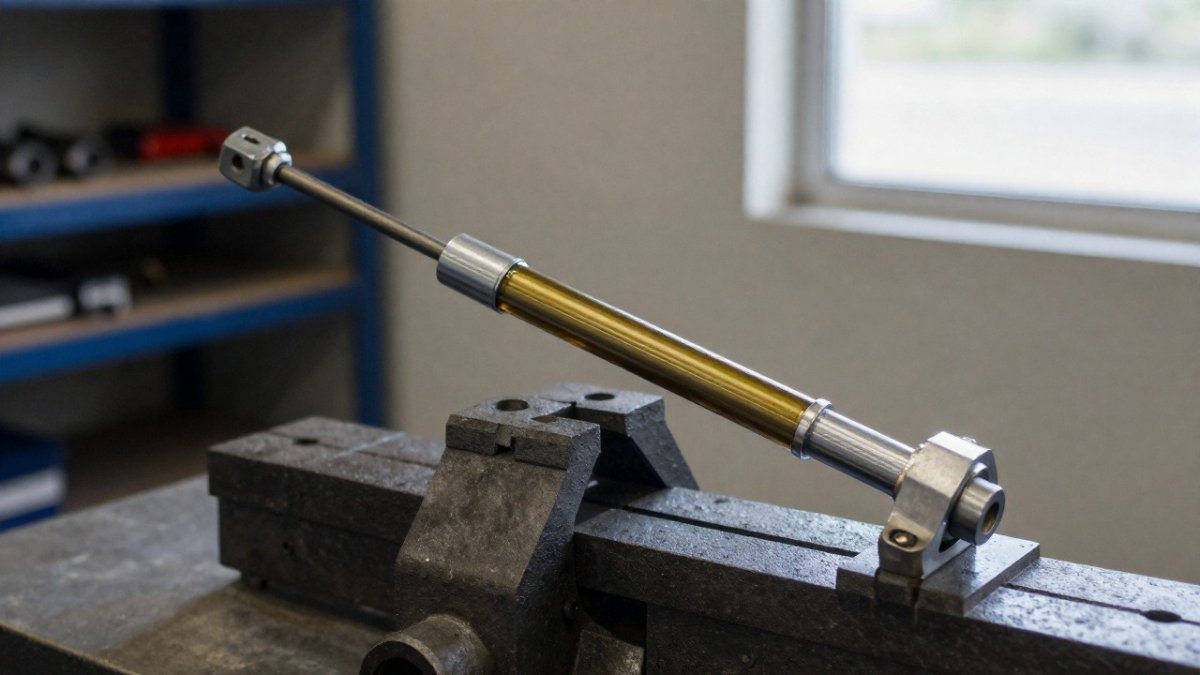
Two architectures dominate, and they behave very differently. A damper rod fork forces all displaced oil through fixed orifices in the rod itself. A cartridge fork runs a sealed damping cartridge with a piston, shim stack and often a separate rebound circuit.
The practical consequence is tuning range. Damper rod forks meter oil through holes of fixed size, so the damping curve is largely baked in at the factory. You can change oil viscosity to shift the whole curve, but you cannot reshape it.
Cartridge forks let you alter the curve itself. Change the shim stack and you change which velocities get damped and by how much. That is why race bikes and quality adventure machines use cartridges: the tuner gets separate control of low-speed and high-speed behaviour.
Fixed orifices also behave non-linearly with temperature. Cold oil through a small hole is far stiffer than hot oil through the same hole, which is why a damper rod fork can feel harsh on the first kilometre and vague by the end of a long descent.
Motorcycle Suspension Shim Stack: How Bending Discs Meter Oil Flow
A shim stack is a set of thin spring-steel discs clamped at the centre, free at the outer edge, sitting over a piston face. At low oil flow the stack stays seated and oil escapes through fixed bleed. As flow rises, pressure bows the outer edge of the discs upward and opens a progressively larger gap.
This is the elegant part: the stack is a self-adjusting valve with no moving parts. It responds to velocity, not to a setting. That is why shim-stack design is the single most powerful tuning lever in a cartridge damper.
Our shim stack fundamentals guide walks through the flex behaviour in detail. Here, note the variables a tuner actually controls: shim diameter, thickness, the order of the stack, and the clamp diameter that determines how easily the outer edge lifts.
Reading a shim stack and predicting its behaviour
Start with the clamp. A smaller clamp diameter gives the shims more unsupported span, so they lift earlier and the stack is softer. Then look at the face shims: thicker or larger-diameter shims resist opening and stiffen high-speed damping.
A common mistake is stacking shims to chase a feeling without recording the baseline. Write the stack down before you change anything: every diameter, every thickness, in order. Without a baseline, every subsequent change is guesswork.
| Stack change | Effect on damping | Typical symptom it fixes |
|---|---|---|
| Smaller clamp diameter | Softer high-speed | Harshness on square edges |
| Thicker face shims | Stiffer high-speed | Bottoming under hard landings |
| More low-speed bleed | Softer low-speed | Skittish feel over small bumps |
| Fewer large-diameter shims | Earlier stack lift | Deflection on rocky ground |
Motorcycle Fork Oil Viscosity: Grades, Brands and Real Temperatures
The viscosity grade on the bottle is not a reliable specification. A "5W" fork oil from one brand can measure meaningfully thinner or thicker at operating temperature than a "5W" from another, because fork oils are not bound to the engine-oil viscosity grade system in the way riders assume.
What matters is the actual kinematic viscosity in centistokes at 40 °C and 100 °C, plus the viscosity index that describes how much the fluid thins as it heats. Two oils with the same label can sit at opposite ends of the range.
Why viscosity grades across brands do not line up
Fork oil labelling is largely a marketing convention rather than a regulated classification. Brands choose their own reference points, so a grade is a rough family, not a number. If you swap brands without measuring, you have changed your damping without touching a shim.
Reading the numbers: cSt, test temperatures and viscosity index
Kinematic viscosity is measured in centistokes (cSt), and the two temperatures that matter for suspension work are 40 °C and 100 °C. The 40 °C figure is the closest standard test point to a cold or lightly warmed fork, and the 100 °C figure approximates a damper that has been worked hard. A fluid that is thin at 40 °C will feel soft on the first part of a ride; a fluid that stays thick at 100 °C will keep damping firm when hot.
The viscosity index (VI) describes how much the oil thins between those two points. A high VI means the viscosity changes less as temperature rises, which gives more consistent damping across a ride. A low VI means the fork feels noticeably different cold versus hot. For a road bike that sees steady temperatures, VI matters less; for off-road or track use where the damper cycles hard, a high-VI fluid is the more predictable choice.
Watch out: a single cSt figure at 40 °C does not tell you how the oil behaves at 100 °C. Always compare both points and the VI, or you are comparing only half the story.
Shear, temperature and real operating conditions
Viscosity is not fixed in service. Oil is forced through small gaps at high velocity, and that shear can permanently reduce viscosity over time, especially in fluids with long-chain additives. Heat thins the oil temporarily; shear degrades it permanently. A fork that felt correct when fresh can feel vague after many hours because the fluid itself has changed, not because the shims moved.
This is why two identical bikes can feel different: one may have fresh fluid of a known viscosity, the other fluid that has sheared and oxidised. Before blaming the valving, confirm what is actually in the fork.
Our measured fork oil viscosity comparison sets out the cSt figures across a large fluid sample so you can compare like with like. A tuner who knows the real viscosity of the oil in the fork can predict the effect of a change instead of discovering it on track.
Watch out: never mix two brands of fork oil to "split the difference" between grades. You have no way of knowing the resulting viscosity, and the blend may foam unpredictably.
Fork Oil Aeration and Cavitation: Foam, Fade and Lost Damping
Aerated oil is the most under-diagnosed suspension fault in the workshop. When oil is whipped by fast damper movement it can entrain air. Foam is compressible, so the damper stops generating consistent force and the fork feels vague and mushy.
Cavitation is the related problem. On a very fast rebound stroke, pressure on the underside of the piston can drop low enough for dissolved gas to come out of solution, forming vapour bubbles. When those bubbles collapse, damping force spikes and then disappears. The rider feels a harsh, inconsistent fork that cannot be tuned out with clickers.
The causes are usually practical: oil level too low, worn seals letting air in, fluid overdue for replacement, or a damper that has been worked hard with old oil. Fresh fluid of the correct viscosity, set to the correct oil height with the air gap measured properly, resolves most cases.
Springs, Preload, Sag and Air Gap: The Setup That Frames the Damping
Springs and damping solve different problems, and confusing them wastes workshop time. The spring rate and preload set the ride height and how the bike carries load. Sag is the measured compression of the suspension under the bike's own weight and then with the rider aboard.
Damping only works correctly within the travel the spring allows. If sag is wrong, the damper is operating in the wrong part of its stroke and no clicker adjustment will fix the handling.
Air gap matters just as much on the fork side. The air gap is the volume of air above the oil in the fork leg, and it acts as a progressive air spring. A smaller gap stiffens the end of the stroke sharply. Set oil level by measured height, not by volume poured in, because residual oil hiding in the cartridge skews the result.
Our fluid mechanics reference explains how oil flow, pressure and restriction combine to produce the damping force you are trying to control.
Diagnosing Damping Faults From Rider Symptoms
Rider language maps to damping faults more reliably than most technicians expect. "Wallows" usually means insufficient low-speed compression or a spring that is too soft for the load. "Harsh over small bumps" points to excessive low-speed compression or stiction, not to the spring.
"Packs down" over repeated bumps means rebound is too slow, so the suspension cannot extend between impacts. "Kicks back" means rebound is too fast. "Bottoms out" on big hits suggests the high-speed circuit is too soft or the air gap is too large.
Before touching a shim stack, verify the basics: sag, oil level, oil condition and clicker positions from a known baseline. A large share of "damping problems" turn out to be fluid that has broken down or an oil height set incorrectly at the last service.
Fluid Service Intervals and Oil Replacement Practice
Suspension fluid degrades. It shears through the valves, oxidises with heat and collects contamination from worn bushings and seals. As it degrades, viscosity drifts and damping consistency disappears, which is why two identical bikes can feel completely different.
Many workshops work to a service interval based on hours or kilometres, with race and heavy off-road use demanding far shorter cycles than road use. The honest answer is that interval depends on how hard the suspension works, so track hours rather than assuming a universal number.
Replacement practice matters as much as timing. Drain fully, measure the volume that came out, flush the cartridge, fit new seals where required, and set oil height by measurement with the fork fully compressed and bled. Record the fluid brand, viscosity and oil height for the next service. Our fork servicing page covers the oil, seal and bushing work if you would rather have it done to a documented baseline.
Book a Suspension Consultation With Mountain Race Shop
Most riders spend years adjusting clickers without ever knowing what the fluid inside is doing. That guessing stops when you understand the mechanics: pressure, restriction, viscosity and stack behaviour explain nearly every symptom a rider describes.
Mountain Race Shop has worked with motorcycle suspension since 1995, and has been a K-Tech dealer since 2017. Craig Dixon is the author of The Suspension Engineer's Handbook, and the business's books cover practical suspension engineering for riders and workshop staff. Visit Mountain Race Shop's website for current services and pricing.
Frequently Asked Questions
How does motorcycle suspension damping work?
Damping converts suspension movement into heat by pushing suspension fluid through narrow passages. On the compression stroke the fork or shock resists the wheel moving upward; on the rebound stroke it controls how fast the spring extends. The size of those passages, and whether they are fixed orifices or bending shim stacks, sets how much damping force is produced at a given shaft speed. Change the fluid, the shim stack or the passage size and you change the damping curve.
What does fork oil do in motorcycle suspension?
Fork oil does two jobs. It lubricates the sliding surfaces of the fork tubes and damper, and it is the working medium that generates damping force as it flows through the damping circuits. Its viscosity affects how easily it passes the shim stack, so a thicker oil increases damping force at the same shaft speed. Oil level also matters: it sets the air gap and therefore the air-spring effect near full compression.
How does fork oil viscosity affect suspension performance?
Higher viscosity means more resistance to flow, which raises damping force, particularly at low shaft speeds where flow is controlled by bleed and shim cracking. Lower viscosity reduces damping and lets the fork react faster over small bumps. Because viscosity changes with temperature, oil that is too thick when cold can feel harsh and then fade as it heats. Always compare viscosity at the temperatures the fork actually reaches rather than relying on the number on the bottle.
What causes motorcycle suspension oil to aerate or cavitate?
Aeration is air being mixed into the oil, usually through a low oil level, a worn seal or vigorous agitation in a damper that is not fully bled. Cavitation is vapour forming in the oil when pressure drops sharply on the back side of a shim stack or piston. Both reduce damping consistency and can feel like fade, vagueness or a fork that dives under repeated hits. Correct bleeding, the right oil level and a shim stack that does not demand impossible flow all reduce the risk.
How can you tell if motorcycle fork oil needs changing?
Watch for damping that fades during a ride, a fork that feels harsh when cold then vague when hot, discoloured or cloudy oil on the dipstick or at service, and metal or seal debris in the drained oil. A service interval based on hours or kilometres is more reliable than waiting for a symptom, because fluid breakdown is gradual. If you cannot remember the last fork service, treat the oil as due and replace it before chasing clicker settings.
What is the difference between compression and rebound damping?
Compression damping controls how fast the suspension compresses when the wheel hits a bump or the rider brakes. Rebound damping controls how fast the spring pushes the wheel back down afterwards. They use separate circuits and usually separate adjusters. Too little rebound and the bike springs back and wallows; too much and the suspension packs down over successive bumps. Both circuits rely on the same suspension fluid, so a fluid problem shows up in both directions.
